NOTES OF A TRIP TO FINLAND WITH CATTLE
By David Murray, Cumnock. Transcribed and researched by Elaine Corbett 2021
Part I
Within recent years such of our local farmers as go in for the breeding of high-class Ayrshire cattle have had quite a close relationship with Finland. Great numbers of Ayrshires have been transported to that country, with the climate of which they seem to do well. So much is this the case that the personality of Mr A. V. Becker, the gentleman who buys the stock, has come to be very well known in this neighbourhood, and it is safe to say that no one receives a more cordial welcome at the hands of the stock breeding farmers than he does. The farmers have come to know that if they have the stuff to sell that Mr Becker wants to buy, a deal usually follows at prices satisfactory to all parties. This spring Mr Becker was in our neighbourhood in search of stock, and it was my privilege to be asked to take charge of the transportations of some of his purchases from this country to Finland. A year ago I had a similar kind offer which I was reluctantly obliged to decline, but this year I was able to accept it, and did accept it. To be quite frank, I was pleased with the prospect of spending a pleasant holiday "out of the beaten track," and that at small, if any cost to myself, except what I might care to spend for my own pleasure.
By arrangement I met Mr Becker at Mauchline on Tuesday, 21st May, and there received from him full instructions for my guidance. His part of our contract was discharged with his well-known courtesy, and so far as the financial part of it is concerned I may say that he discharged it "forehanded". Armed with a health certificate and a letter of introduction to the Shipping Company - which , by the bye, was never needed - I took charge of my stock, which was placed in three wagons with plenty of room and fresh hay, the cows being sheeted. As for myself, I travelled comfortably in the guard's van. At Dumfries we picked up a nice consignment of heifers from the famous Barcheskie herd, which completed my lot. All told, I had thirty-two animals under my charge, including a cuddy and four young calves. At Carlisle the stock was transferred to the charge of the Midland Railway authorities, and in good time Leeds was reached. At Leeds there is an enormous goods yard, and to a stranger it must partake of the mysterious to understand how such a number of lines can be managed with the safety and despatch which characterises the work. An hour was spent here in getting our train ready for the next portion of our journey - from Leeds to Hull - and in order to while away that hour I found a comfortable refuge in a large signal cabin. The signalman in charge, like myself belonged to the land of "brown heath and shaggy wood," and in his congenial society the time soon sped away. A yardsman kindly let me know when the train was ready. Without a guide any one might be excused if he got a little "fogged" in getting to any desired point amid such a mass of moving traffic, but my guide kept me right, and after I had made an inspection of my stock I took a seat in the van. A real old English guard was my chum for this part of the journey, and he proved to be a most agreeable companion. Among the things mentioned, he told me that we were booked "Special, Class A," which fact, I supposed , was meant to impress me that his was a very important position. Considering the very heavy passenger traffic at the time, there was very little delay experienced, and early next morning we were close upon Hull. Down I got and found my way to the ship, which was names the "Arcturas". An official came back with me, and until the cattle got shunted round to the unloading bank my new friend and the chief yardsman showed me over the Railway Company's new stable buildings. These cannot be described as elaborate, but I was impressed with the useful and sensible way in which they had been planned and arranged to hold about sixty horses with all conveniences required. The Company seem to take a very real interest in their horseflesh; many of the teams - they are nearly all worked in pairs - are very good and give every evidence of being well cared for. When the cattle had been brought round to the unloading bank they were tied to a large lorry - no pens being available - and I saw to the cows being milked and all the animals fed and sheeted. They were very contented in the warm sunshine and seemed quite at home. Quicker than one could have believed it possible two o'clock came round, when the order to "fetch the cattle" was given. All hands seemed anxious to get to this job, but soon a few were specifically told off and quite a long drive was begun, and with ropes tucked around their horns we drove the cattle loose, but of course led the bulls and donkey. The bulls were in great spirits and required a good deal of managing but we got every consideration from the people using the streets, although the cattle were as persistent for getting in the way of the foot passengers and wheeled vehicles as they are at home.
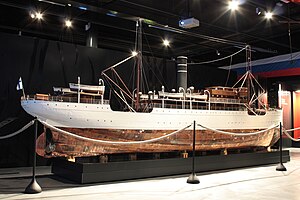 |
| A Scale model of the Arcturus by Tomi Isopahkala in the Maritime Museum of Finland from Wikipedia |
Link on Wikipedia to details on the Arcturus and her role.
When we arrived at the docks I had my charges placed at one end of a great shed, with plenty of fresh hay and water, until the quarters on board ship were ready for them. By-and-Bye the order to embark came, and the kindly cattle walked on board, led by the halters without any difficulty. They were placed on deck tied to temporary fittings - a row up each side, tail end to the water. Mr Cuddy got the place of honour on deck between the rows, but before he was allotted his place about two tons of baled hay was built here - a nice, cosy nook being formed in the centre for the wee calves. The donkey was a great favourite all round; many of the foreigners were much interested in him, and among the first-class passengers he had many friends. Thus our life afloat began. Not a soul did I know, but with plenty of work on hand one never noticed that. The officers and men as well as the passengers, took a great interest in the stock. Several of the Finnish women on board offered, through the officers, to milk the cows, and I agreed to allow them to do so after satisfying myself that they understood the business, and right good milkers they proved to be, I allowed them some milk by way of remuneration, and was pay of a very acceptable kind, as I learned later that quite a number of steerage passengers had babies with them, so that the arrangement suited both ways. While the four calves required a good deal of lacteal nourishment, the milk of the cows - although their feed was only hay and water - kept up well, and there was always some to spare. In a short time, thanks chiefly to the attractions of my stock, everyone knew the "Cowboy". My quarters in the second cabin were most comfortable, and the cuisine left nothing to be desired. To begin with we were a small party, but at Copenhagen quite a lot of passengers came aboard, so that instead of having a nice cabin to myself it was a case of three in one. All of them, however, could converse in English. A young student returning from studying textiles in Manchester, and a Finnish gentleman who had done well in the drapery trade in Portland, U.S.A., and who, with his wife and family was re-visiting his native place, and myself soon became great friends, and we made a very happy family. Although travelling second cabin we could not have been better off. As already stated the cooking and service of the food was first rate, but it was not quite like our own. At eight o'clock coffee and cakes were served in the smoke room, but toast, like tea, was always conspicuous by it's absence. Then about ten o'clock a very elaborate breakfast was served. At three o'clock we had dinner with no end of tasty dishes. Once I counted fifteen various kinds of what we in this country call "kitchin". The method of serving is also quite different and the soup comes near the end of the meal. On Friday we arrived at Copenhagen.
Part II
As was mentioned at the close of the last article, we arrived at Copenhagen on Friday 24th May. The approach to that city did not strike me as being particularly interesting. The coast line is low lying, and with the lazy looking windmills that were to be seen, I was prepared to find a quiet and somewhat old-fashioned place. But there was a surprise in store for me, as Copenhagen turned out to be a place of great beauty and importance. But I am anticipating. So far the weather both by day and night had been lovely, and everything had gone well. At night the large space where the cuddy and the calves were placed was covered over with a very large waterproof cover forming a big marquee after the style of *Lord George Sanger's canvas stables. The children on board, it might be mentioned found a special attraction in the calves and cuddy. As we drew near land all the cattle became very greatly excited. At last we got safely moored and very soon all is again bustle on board, and what a busy scene it was. The cattle got well covered in all round, the calves and cuddy cornered out of the way, hatches are opened and the work of emptying the hold begun. While this was going on I took a sharp walk round our dock, past the railway station and up a very pretty avenue with well kept lawns, shrubbery, etc. Further along I came upon a stretch of lake with well wooded bank and with several swans disporting themselves in the water. The whole was surrounded with a low railing of artistic design, which made up a picture to be remembered. By-and-bye I reached the city proper. The first group of houses were just like what one expected to see, and were not unlike our colliery rows, only they are two storied with small windows and outside shutters. Some of the windows are fitted with a contrivance not unlike an old fashioned stable lantern. This I found was a mirror arrangement to show to anyone sitting at the fireside what was passing on the street without leaving their seats. For downright laziness this would be hard to beat. Then I came to the business part of the city, and it is quite up to date. The shops are very nice and the windows are dressed with much taste, but there was no door display. The principal streets are all tar macadamized, and an excellent service of electric trams is in use. Many of the cars are run double - apparently coupled together. The people on the streets were smartly dressed and most of them had a very well-to-do appearance. The King's residence is situated in a large open space, octagon in form, and decorated with pretty trees and a statue. The whole space is well paved and very clean looking. Wherever there was room a tree grew, so that the place was well decorated in this respect and they added a distinct charm to the scene in their Spring freshness. After seeing so much of what was to be seen I returned to the ship, determined to further my acquaintance with, and knowledge of, this handsome town. But "the best laid plans of mice and men gang aft agley", and I experienced the full truth of that maxim, for in the midst of much bustle and work on board I deemed it expedient to stand by my charges for the remainder of the forenoon. This, however, had its interesting side, for among the quay workers I soon discovered a man with rare gift of tongues. Among the languages other than his own he could speak English fluently, and yet he was doing donkey work - a common labourer. What a waste.
*Lord George Sanger - circus owner
On Saturday afternoon we set out to sea again, and when no duty required to be performed the most interesting thing that could be done was the "sizing up" of newcomers. These were of Russian, German and Finnish extraction, and most of them seemed to be business people. Three ladies were among the company. Every nook and corner was occupied, and again my charges came in handy in enabling one to form acquaintanceships. All and sundry came my way, or rather the way of my cattle. Many of my visitors could speak English well. One very agreeable young gentleman - an Austrian, I think - could speak it without so much as a pause, and he was never at a moment's loss to find a word or a phrase to express exactly what he wanted to say. His versatility was amazing, and at supper he created much amusement by cutting out a German who was posing as a Frenchman with gushing talk and exaggerated gesticulations. Though very deaf in my French and German ear, I could not help enjoying the fun which ended in "Old Sausage" being bottled up for the rest of the voyage, and that to every one's amusement. Two of the ladies were of the big, fat, grumbling order of humanity - eating, drinking or smoking all the time. Even on deck they did not seem able to enjoy the fairest scenery or the most enchanting moonlight without having something at their elbow to eat and drink. Theirs was a great existence indeed. One of the ladies had a complexion which, without being ungallant, I can only describe as like a boiled lobster, and I wondered what it would be like a few years hence. Saturday night was lovely so far as the weather was concerned, end everybody seemed to find their greatest pleasure on deck. Sunday was also a beautiful day, and the waterproof covers were all removed and the cattle lay cuddling in the warm sun. They were now living in absolute peace among themselves and showed no inclination to pummel each other as they had been apt to do at first, each being strange to the other. On Sunday the general routine of the ship's work was much relaxed and many of the crew came my way. Very few of the sailors could speak English, but they were all good fellows and most obliging. On that day I visited the steerage; it was a sight; but what must it be in rough weather. With plenty of sunshine and fresh air it may not be bad, but when storms rage and rain falls it must be miserable. There were however, some very nice people among the passengers. I became acquainted with two - a young man and his wife - who were "roughing" it, preferring to save the difference between steerage and second cabin in order to have more money to spend in their beloved Finland. I learned that day for the first time that no fewer than Nineteen women were employed on the steamer. They were all of Finnish nationality and tall of stature. They keep their hair very neat and tidy and never appear in curling pins, which cannot be said of some of our young ladies at home. When breezes blow they invariably cover their hair. No shop teeth were to be seen, but it would greatly improve their general appearance if these damsels would pay a little more attention to their footwear, and give up the wearing of buttoned boots - things that are seldom neat after a few days' wear, and, when size seven predominates, are simply hideous. Up till now the wind had been in our wake, but today it is right ahead, so that our speed was a little reduced. On the previous evening the cuddy had made himself slightly obnoxious by his "hee-hawing", and I wondered if this meant a change in the weather. The change in the direction of the wind might betaken as more proof that Mr Donkey had some claim to kinship with a well known weather prophet, whose predictions, however, are not always to be relied upon. In any case we had a change of weather in store, for the setting sun looked angry and heavy, dark clouds built themselves up against the horizon. I have already indicated in a general way the nationalities of our passengers. The Germans were a hearty lot and got through a great deal of talking. The Russians were quite different and usually wore a rather dour or morose countenance. Several of them played cards all day, and even hurried through their meals in order to resume their play. This was not quite a Scotsman's notion of how to observe the Sabbath day. During Sunday night a change of weather came, and Monday opened wet, cold, and miserable. The cows had all to be sheeted and thoroughly protected, and after attending to their living place preparations were set agoing for landing at Helsingfors, and we reached that port about one o'clock in the day. The tall figure of Dr. Sawela was easily distinguishable among the crowd waiting on the quay and right cordially he saluted the "Cowboy", who was then standing on the gangway above the cattle deck. The Doctor was the centre of a group of people, all of whom were evidently much interested in the arrival of the cattle. With very little delay the "way out" was arranged, and the handing over and the taking delivery began. After looking at the cattle the Doctor soon identified each one of them. After each identification he shouted something, whereupon some one stepped forward to claim the animal thus identified and led it away. A lady farmer who took two beauties away - a bull and a cow - kindly invited me, through the Doctor, to visit her farm. I would gladly have gone if the doctor had gone too, but, unfortunately he could not go, so I had reluctantly to decline the invitation, as with no knowledge of each other's language we would have been about as helpless as were the Bible folks who had to stop building their skyscraper owing to the confusion of tongues. After all the cattle had been placed in charge of those who came for them the Doctor carried me off to a hotel, where he treated me in kingly fashion to a first-class luncheon.
Part III
In the hotel Dr. Sawela and myself were joined by a friend of the Doctor's, and although he had "no English", the Doctor admirably acted as interpreter, and so we all got on well with each other. The meal served to us was after the steamer style, with smokes between the courses. Everybody seems to smoke cigarettes, the making of which is a big industry here. But what an apology the beef was for roast beef. It was like a poor quality of beef ham, and cooked to - nothing, and almost insipid. It seemed to me that Finland required beef-making as well as butter-producing cattle if the stock of roast beef is anything like the sample I had. Helsingfors is quite a nice city, but it is not so well paved nor is so well kept as Copenhagen. There are, however, several very pretty parks - one quite near the harbour is a particularly pretty one containing a handsome bandstand, restaurant, retiring rooms, etc. In summer it must touch the beautiful, but I saw it in rather wintry surroundings, but even then it was pretty. On the heights above the town I found vegetation quite three weeks behind Scotland, but it should be remembered that this place is about the same latitude as the Shetland Islands. In rambling round Helsingfors I chanced upon a very much decorated road leading up to a public building which was also gay with flags and bunting. There was a great commotion in its vicinity and I found that that was "Children's Day" in the city, and it appeared to have taken a thorough grip of the inhabitants. The weather, unfortunately, was much against it, but the enthusiasm did not seem to suffer on that account. A great programme of indoor entertainments made up for the out-of-door disappointment, and it looked as if no trouble had been spared to make the day a big success. All sections of the huge procession represented some scene of interest or historical incident; many of the characters used carriages while many were mounted. Next day I came across many of the teachers and helpers in gaily decorated Phaetons or on horseback, all in fancy dress. They were making door-to-door calls and with their little collecting boxes, something like our Lifeboat Saturday system at home. The collectors also asked the people on the streets for assistance and they seemed to get a very hearty support form every one. After having had a good turn round the city I went back to the ship, where I had arranged to sleep. I found that everything was being turned up like a veritable spring cleaning. For the first time it was a trifle dull, as my cattle had gone, as well as the English speakers.
Tuesday morning - I had been exactly a week away- opened very cold, but clear and clean, just like a good British winter morning with no snow. I watched the discharging of an immense quantity of flour brought from Copenhagen, and was much pleased to hear one of the maids singing at her work. It sounded just like "Ring a ring a rosy" of the Cumnock schoolchildren. Just then another pleasure was in store for me, as Mr Lindholm, one of my cabin friends, came back to see me, bringing cards for my little ones at home. He asked about everything since we had parted- how the cattle had been delivered, where I had slept, how I had passed the time, etc. then we went off for a walk and, still better, a talk. Mr Lindholm is a born Finn, but residence in England has given him a knowledge of our language. All shyness in using it has disappeared and he talks well. We visited many interesting places in the city, and among them the University and High School. Here we met many young gentlemen who could speak English with great fluency. One of them, a bright young fellow, had studied for three years in America, and he looked out and out a most promising lad. His forte lay in freehand and mechanical drawing. After visiting one of the Park Restaurants and indulging in a short rest and the inevitable coffee and smoke, Mr Lindholm and I went to the British Consulate for the purpose of paying our respects to the Consul. We arrived just as he was leaving, but he kindly waited a little and treated us with much courtesy and kindness. I had no passport, and without one there was a possibility of some difficulty in my getting away. The Consul promised to meet me at the ship before sailing, which he did, and by his good offices the "Cowboy" was allowed to start for home. Had it been a week later stricter rules would have been enforced, owing , I understand, to the fact that some bomb-making had been discovered just over the Finnish border. A few of the old cabin lot were returning with the steamer. A great crowd of emigrants on their way to America joined the steamer here - 480 of them - men, women, and children.
As the vessel left the quay the emigrants broke into song - well, it was not "Auld Lang Syne", but something that seemed to serve the purpose and the same sentiment might be expressed. Going out from Helsingfors was most interesting. A new friend, introduced by the British Consul, made things very pleasant for me, and explained ever object of interest that we passed. There is little wonder that this place is called the Gibraltar of the North. A very narrow passage just lets the steamer in, and on the several islands Russian cannon bristle everywhere, thus effectually guarding the entrance. After getting our into the open sea the rain began to fall heavily and there was a heavy roll on. Only five persons answered the summons of the supper bell; soon only four were present; then the other three left rather hurriedly, and I alone remained. The weather got worse, and at midnight a regular storm was raging and in my humble judgement it could only be described as dreadful. In our cabin six of us tried to sleep, but few were successful in wooing the drowsy god. Those who did not sleep, grunted and made sundry remarks, but not one word of English was to be heard. Early in the morning Hango was reached, and, like Helsingfors, it is difficult of approach but eminently safe once you are inside the harbour. This is the port which the Finnish farm produce is shipped, and trainload after trainload of butter etc. comes alongside. What a vast quantity of butter our steamer took aboard. In five minutes I counted 75 barrels of it; indeed, the operation had to be seen to be believed. The method is to pass a rope round five barrels at a time and by means of a derrick worked by the ship's donkey engine they are whipped from the waggon down into the hold in a jiffy. And so the loading goes on quickly. In looking into the deep hold of the ship it looked just like a very large floor of wooden blocks. A huge pile of raw hides were lying on the quay, and I thought if they were at all like the roast beef, the boots manufactured out of them would wear a very long time. While all this was going on a butcher in pink smock and white apron was busy putting rumps of beef into the storeroom. It was rather poor looking stuff and not at all well finished. No fewer than three of the Company's boats were here at this time - one from Stockholm to Helsingfors, one from St Petersburg, and our own. They were all very trim and nicely painted - white with gold ornamentation, and black funnels with two white bands. I took advantage of the opportunity to have a run on shore, when I found that Hango was not at all a bad looking place. The houses were small and all were built of wood on stone basements. A few outside steps up to the floor gave the street and old-fashioned look. Near the harbour is quite a little street of wooden shops, all seemingly to be engaged in the same business, namely, the sale of brown bread, sausages and a variety of coloured liquids in bottles, for drouth , I suppose. The shops are largely patronised by the emigrants.
Ere we left this pleasant harbour the weather had cleared up a bit, and the Baltic behaved much better than the gulf of Finland had done. The emigrants were rather a funny looking lot. They were mostly young, and looked as if they could do a hard day's work, although several did not seem fit to begin life anew in a strange country. As I stood on the upper deck and surveyed the motley throng below, it was a queer medley of tongues that greeted my ears. The garb of the emigrants was of every conceivable description, and I did not doubt but many of the old clothes collected in Britain were represented there - at least, they looked the Briton of a bygone day. There were a few young women not at all bad looking, but very poorly dressed. My impression of the Finlanders is that they are possessed of not a few of our Scottish characteristics. By-and-bye the roll of the ship became troublesome, and the saloon became a scene of sickness and misery. A heavy snow began to fall and the piercing wind seemed to cut into the very bone. Well muffled up I kept in the open air until things got a got settled, and then lay down in the smoke-room in my overcoat. At length the storm moderated, and I sought more comfortable quarters, and was soon unconscious of the warring elements on the outside. When I awoke Gothland was in sight. Between it and us a fine large sailing ship was standing up bravely to the breeze - a fine subject for a painter. To pass the time I went off to see the emigrants partake of a meal. Two men carried a large tinful of coffee, and another lot brought two potato-looking baskets filled with "pieces" made up of a large slice of buttered brown bread and a chunk of sausage or cheese on top. The mate took his stand at a large table and shouted "Cooshet" - or a word like that. Then the emigrants swarmed round and took a "piece" and a tinful of tea, and then sought a quiet corner to put them out of sight. On the whole the behaviour was very good. Their dinner consisted of soup which smelled and tasted well, beef, potatoes and pudding. The place was like a large cellar, lit by the porthole windows only, so that it was not quite enticing. Tight up one side of the ship was the sleeping accommodation, where they crawl in one above the other three deep.
In consulting the log I learned that we had made 98 miles on our homeward journey, and for the first time no one answered the supper bell. I could have eaten, but the stifling atmosphere, combined with the rather un-pleasant sounds made by the sufferers, was too much for me, and I preferred to fast for once, and so stayed away. Next morning broke fine, and it was surprising how brightly all appeared at table laughing over the miseries of the previous night, though many must have suffered acutely. From days of "table" observation I wondered if women were more exacting - or shall I say tyrannical - than men. I am afraid this is the case, so when Mr Todd's women's cabinet **is formed the waiters on the Terrace of St. Stephens may look out for lively times. May the fair one's generosity make up for their persistent claims for attention in many cases more cranky than necessary.
* * Women were granted the right to vote and become members of parliament in Finland in 1906
In the Baltic the weather was a good as it had been vile before, and at four o'clock next morning we reached Copenhagen. It was quite a pleasant sensation getting in touch with land again. Halting in the bay we were rapidly approached by a very business-looking little steamer with great pads or fenders round her sides. She was cleverly manoeuvred along-side and a nimble pilot climbed aboard and took charge of our ship. Off went the little steamer and our big one began to move cautiously forward. On touching the quay and after having had a good drink of hot coffee - which went down fine after the cold morning - I went off alone to make the most of a few hours here. I walked round the fish market, and also made a tour of inspection of the meat market. The fish trade was very much like what it is in Glasgow, but the meat seems to be under a very rigorous system of inspection - even feet, heads etc., are examined and stamped. Many of the streets are very fine, and everywhere they are beautified with trees which were in full leaf and thus looked much better than the trees in Helsingfors. Some of the statues are very fine, and being erected in large paved square, they are well shown off. I noticed very little smoke, which no doubt was all in favour of the foliage.
Many left the steamer here, and not one remained who could speak English. Among those who did not leave us were half a dozen nice children, and children always make good chums. So it proved in the present case. The dreaded Cattegat and Skagerack were passed in comfort, but the North Sea made up for the omission. All day long we rolled and tossed about in it. Often was the propeller thrown high out of the water, and it raced with such fury that it shook the vessel like an earthquake. No one could leave his cabin, and food was out of the question. It was really wonderful how these little children behaved, confined as they were in bed all day. On Sunday morning the English pilot came aboard and I felt quite jolly after twelve days' total silence of things British and home.
We reached Hull on Sunday, and as the afternoon was extra fine I made a good round of the nice places of that town. Piloted by the baggage master we visited the principal streets and parks, and viewed the public buildings and statues. A fine monument stands to the memory of the South African heroes who fell in that country, and it attracts much attention. It is undoubtedly a fine piece of work. Of a good height it represents one of the sad scenes of the war. A mortally wounded soldier is lying behind a rock and handing cartridges from his bandolier to a comrade who, rifle in hand, is all alone. There is however, too much British bluff about the standing figure, which is quite exposed to the enemies'
Kingston Upon Hull Boer War Memorial
From Imperial War Museums |
After some more sight-seeing I bid good-bye to my valuable and kindly friend and take the train for Leeds. On the journey I got into an argument with a fellow-passenger who, it ultimately turned-out, knew a Cumnock man in the Lake district, and for whom he had a high respect. This made us friends and he saw me right at Leeds for the Midland connection for Carlisle. Here again I was lucky and got "great" with the Traffic Superintendent, who was very intimate with the late John Mathieson, General Manager of the Midland Railway Co. This gentleman was very kind and made me most comfortable during the long wait for the north going train. He saw me right into a corridor carriage and never once was I disturbed until Cumnock was reached a little after five o'clock in the morning. Thus ended a splendid holiday which, among other things, had left me wondering where all the nasty officials are kept who worry some folks when they go from home. I must admit I quite failed to find them.
*********


